



Earlier in the year I published two pieces on causal mapping in football. The first used basic causal analysis across 2,140 Premier League matches to separate myth from signal. The second plotted every factor by how much pundits discuss it against how much it actually affects results.
From this we learned quickly that most football chat is baseless. Form, weather, travel distance, fixture congestion all clustered top-left: talked about constantly, causally irrelevant. Wage bill gap and crowd size sat bottom-right: barely discussed, strongest effects in the data. The gap between where the bubbles were big and where they sat on the x-axis was the gap between received wisdom and evidence.
The same chart could be drawn for most commercial organisations. Most of the effort is spent focusing on the things that the data would tell us just don't matter. Meanwhile there's quiet neglect of the things that do. And then a harder question nobody's really asking: who owns the budget for finding out the difference?
The intelligence budget: the people v the tokens
Every commercial organisation invests in intelligence. They just don't call it that, and nobody owns it as a whole.
Data science teams, analytics platforms, econometric studies, agency reports, dashboards, forecasting tools, AI pilots. All of these exist to improve commercial decisions. But they sit in different budgets, report to different leaders, and get judged by different standards. The net result: no single person owns intelligence as a whole.
That wasn't a pressing question when intelligence meant hiring people who analyse things. Analysts sat inside functions and produced what those functions could afford. The budget was headcount. The governance was line management.
AI changes the economics. A Bayesian model that continuously updates commercial priors costs a fraction of a permanent analyst. An LLM that explains model outputs in plain language replaces hours of report writing. But the model often sits in a technology budget whereas the analyst sits in a headcount budget. Different owners, different approval processes, different expectations of return.
And the question most organisations aren't asking: for each commercial decision, who decides whether it should be supported by a person, a model, a test, or nothing at all? And where does the budget for that come from?
Three questions every commercial leader should be asking
The same phrase from three different leaders means three different things. A CFO asking for "better data" wants forecasts they can defend. A CMO asking for "better data" wants to know which spend is working. A CIO asking for "better data" wants a cleaner architecture. While all three are reasonable, they're all different questions, and the budget that answers one won't answer the others.
In my experience when a commercial leader says "we need better data" or "we need to understand what's working," they're usually conflating three separate things.
The first is where to invest in understanding. The impact of many commercial decisions are assumed but never fully measured. A business believes promotions lift demand, or that price changes affect mix, or that brand spend improves conversion. Until those relationships have been isolated and validated, they're still assumptions. Closing those gaps requires hard analytical investment to run a test, build a model, fix a data pipeline. So not a marketing question or a technology question, but a question about how much the organisation is willing to invest in actually knowing how its commercial system works.
The second is where to invest in commercial activity. Once you understand the system better, you can decide which levers to pull, how hard, and in what sequence. Price, promotion, channel mix, investment allocation. This is where most organisations focus their attention and their money. The quality of these decisions depends entirely on the intelligence underneath them. Strong execution on weak understanding compounds error faster.
The third - and probably the newest question - is where to invest in automation. Which decisions could eventually be made by a system rather than a person? This is where most of the current AI excitement sits. But it's downstream of the other two. You can't automate a decision you don't understand causally.
Most organisations conflate these three, or only think seriously about the second. Plenty of spending on commercial activity. Minimal investment in understanding whether that activity works. And premature automation of decisions nobody properly understands.
Then there's a second problem underneath this. Even the spend that does get classified as "commercial activity" is often justified by benefits nobody has tested. Initiative A will deliver +3%. Initiative B will deliver +2%. Initiative C another +2%. Stacked together, the board's plan now shows a headline uplift that depends on projections nobody validated, then stacked together as if they don't overlap. When the numbers don't land, nobody can say which initiative actually worked, which was noise, and which was confounded by something else happening at the same time. The budget gets built on assumptions dressed up as commitments. Mark wrote about this in The problem with business cases and the pattern hasn't got any better since.
Moving up the rungs of causation
Judea Pearl makes a critical distinction in his Ladder of Causation between seeing, doing and imagining. Most commercial analytics sits on the first rung: what correlates with what. To move up the ladder and begin to understand not just 'what happened when' but 'what caused it' we need a causal map.
A causal map of a commercial system does for business what those Premier League DAGs did for football. It shows which relationships are understood, which are guessed at, and which haven't been looked at.
That matters because each type implies a different investment.
Where relationships are understood, backed by validated evidence, they can potentially be monitored or automated. A Bayesian model can watch them continuously and flag when something shifts. Human judgment adds less marginal value here.
Where relationships are guessed at, where the organisation assumes a connection but hasn't tested it, the investment should go into understanding. Run an experiment. Build a model. Fix a broken data pipeline. Someone has to decide that's worth doing.
Where nobody has looked, the causal map surfaces the blind spot. Then the question is: do we invest in finding out, or accept the uncertainty and the risk that comes with it?
Once those relationships are visible, the organisation can prioritise intelligence investment the way it prioritises any other scarce resource, by asking "where does additional understanding create the most value?".
That question matters most where relationships are interconnected. A gap at a high-leverage node, one with many downstream dependencies, is worth more to close than a gap at the edge of the system. The causal map tells you which is which.
The operating model underneath
Having identified that intelligence is a genuine enterprise resource, it needs to be addressed and actively managed by the commercial operating model.
AI creates a category of resource that doesn't fit existing budget structures. A Bayesian system that continuously updates beliefs isn't a technology cost in the traditional sense. It's doing work that previously required a person. An LLM that translates technical findings into language commercial teams can act on isn't a software licence. It's replacing a communication function.
Azeem Azhar has been making this point forcefully on his Exponential View podcast. His argument: organisations should start thinking about their token budget the way they think about their people budget. He goes as far as suggesting a rough 1:1 ratio, which feels punchy, but the underlying point holds. Tokens are a productive input, not an IT line item. Treating them as infrastructure cost to be rationalised away from the business misses what's actually happening: a category of work is moving from headcount to compute, and nobody is managing that allocation as a single decision.
So the question for commercial leaders needs to be: for each commercial decision, what's the right blend of human judgement and machine inference, and who is accountable for that allocation over time?
That allocation will change. As data improves, models get stronger, and trust builds, some decisions will move from human-heavy to machine-heavy. Others shouldn't, because they involve strategic judgment, ambiguity, or trade-offs that models can inform but not resolve. Leadership's role is to decide where that boundary sits and how it shifts.
Right now, nobody owns that decision. Technology teams buy tools. Commercial teams hire people. Data science teams build models. Finance approves each line separately. Nobody sits above all of it and asks: is this the right allocation of intelligence for the decisions we need to make?
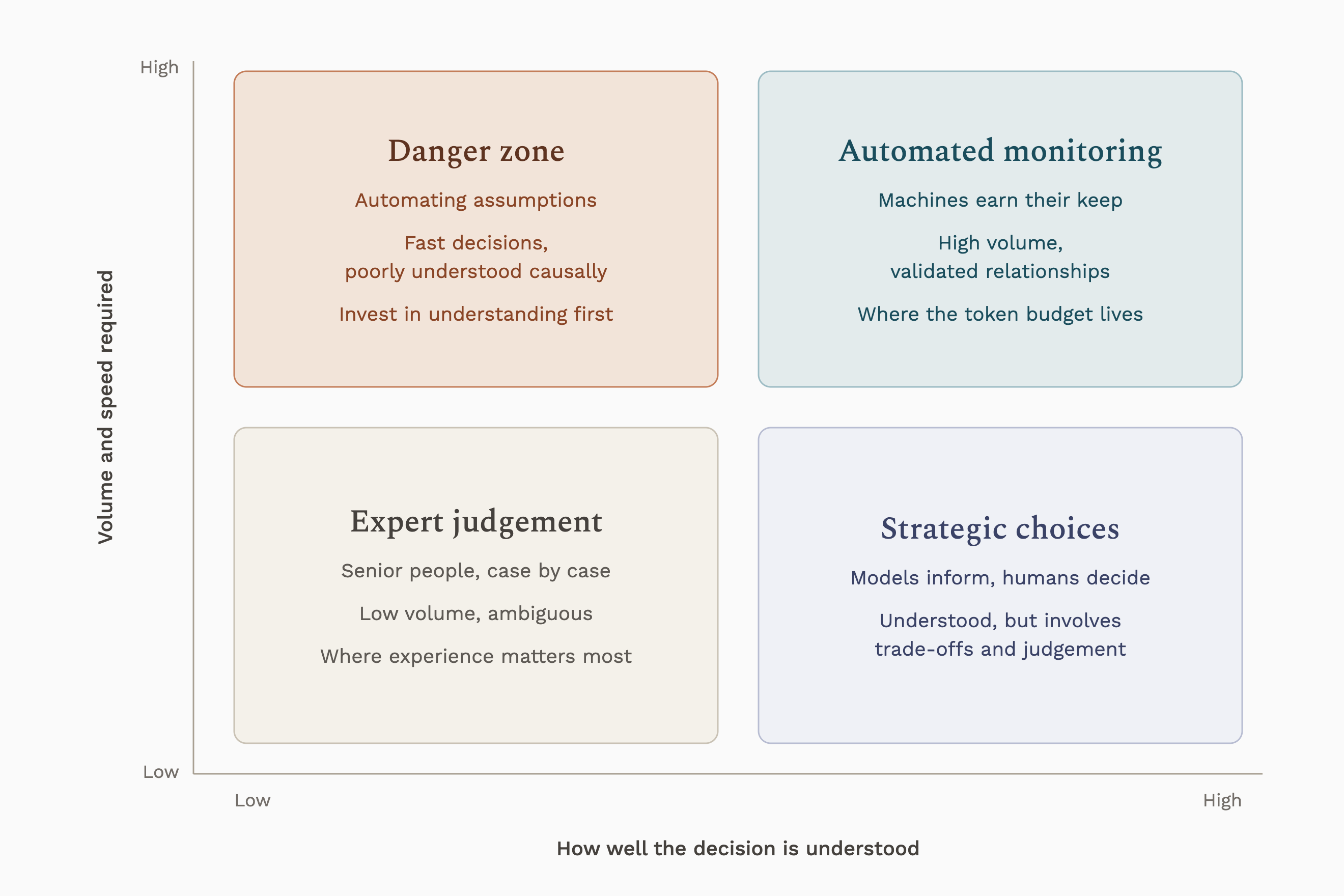
What this looks like in practice
Take marketing effectiveness and yield management. Most organisations have a view on each. A marketing mix model that tells them roughly what spend drives what revenue. A pricing or revenue management system that optimises yield. Both can be good in isolation. But they almost never share a view of how they affect each other. Promotional pricing pulls forward demand that the MMM then attributes to the campaign running at the same time. Marketing spend shifts price elasticity in ways the yield model doesn't see. Each team optimises their own model. Nobody owns the interaction between them.
That's exactly where a causal intelligence layer earns its keep. Not replacing either model. Sitting above them and asking: are these two views of the world consistent, and where are they conflicting?
The broader practical version is simpler than it sounds.
Start by mapping the commercial system causally. Not "what metrics do we track" but "what actually drives what, and how confident are we in each relationship?" That map shows immediately where intelligence is thin, fragmented, or missing. Some of those gaps are worth closing. Others aren't. The map helps you decide.
For each gap worth closing, the next question is what form the investment should take. A person dedicated to ongoing analysis. A model that monitors continuously. A one-off experiment to validate an assumption. Each has different costs, different timelines, different budget implications.
Over time, as understanding improves, some of those decisions can be progressively automated. Not because automation is the goal, but because certain relationships become well-understood enough that a system can manage them reliably, freeing human judgment for where it actually matters.
The sequence is: understanding before activity, activity before automation. Most organisations do it backwards. They spend heavily on commercial activity and AI tools while underinvesting in whether they understand the system those tools are supposed to optimise. The football equivalent: buying a striker because the goals column looks light, without understanding why the midfield isn't creating chances. The symptom gets treated. The cause doesn't.
The leave behind question
Next time your data science director asks for more headcount, or your technology team proposes an AI pilot, or your agency recommends a new measurement framework, ask this:
Does this improve our understanding of how the commercial system actually works? Does it improve the quality of a specific decision? Or does it automate something we haven't properly understood yet?
If nobody can answer that clearly, you probably don't have an intelligence budget. You have intelligence spending, and in most organisations nobody owns the difference.