


Pundits have a stock phrase for the flair team who supposedly can't handle a wet, cold night under the lights in Stoke. We wondered how much of that kind of received wisdom actually holds up. So we took a full Premier League season, 2,140 matches, and mapped what really moves a result against what gets talked about.
The picture is the point
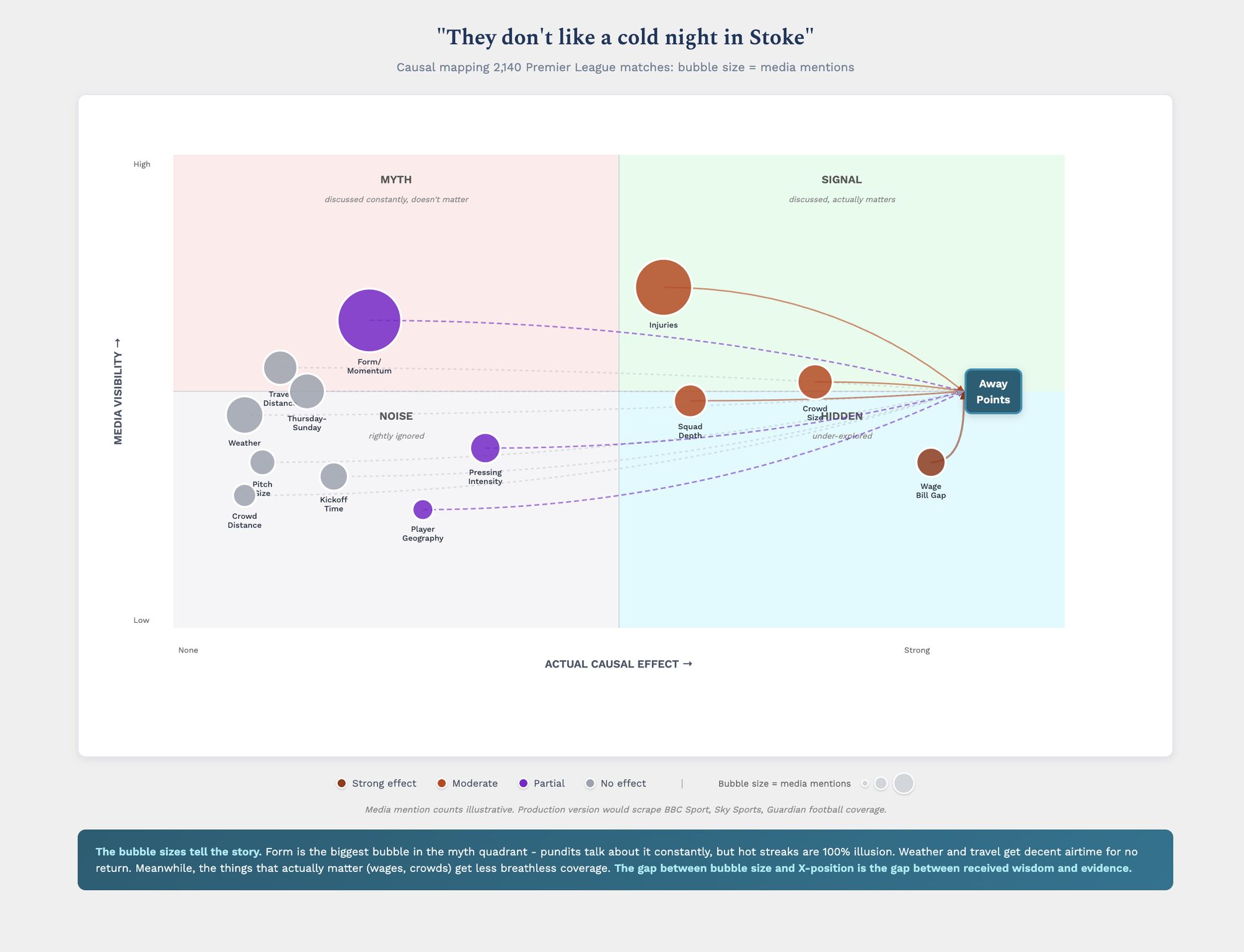
Plot every factor two ways: how much media attention it gets, and how much it actually changes the outcome. You get four quadrants. Things that are talked about and matter. Things rightly ignored. And the two awkward ones: the myths, discussed constantly while doing nothing, and the hidden drivers, quietly deciding matches while nobody mentions them.
What the data shows
A few things fall out.
Weather doesn't matter. We tested rain, wind, temperature and combinations of all three, and found nothing that survives scrutiny. The cold night in Stoke is folklore. The data doesn't show it.
The wage gap does the quiet work, and almost nobody puts a figure on it in the moment. Annual wage tables get their day of coverage, but match by match the commentary talks about "quality" without saying out loud that one side is paying far more for its squad than the other. It's the least discussed of the big factors and it does more work than any of them.
Where we stopped ourselves
Kickoff time is where we had to stop ourselves. The late television slots look like they carry less home advantage, which would have been a tidy finding. But broadcasters pick the stronger away sides for those games, so the slot and the quality of the opponent are tangled together. We can't separate them, so we don't claim the effect. That restraint is the whole discipline. The moment you can't tell two explanations apart, you say so, rather than crediting the one you prefer.
Form is the one we're most careful about. Momentum is the pundit's favourite word, and hot streaks do look a lot like illusion, with teams drifting back to their level. But a few cold-run examples made us hesitate before writing the whole thing off. So we treat it as a question worth testing properly, not a result. We'd rather under-claim and be right.
The gap is the message
The map's real message is in the gap. The biggest bubbles, the factors that get the most airtime, sit on the wrong side of the picture. The things that decide matches sit quietly over on the right with barely a mention. That distance, between what gets said and what the evidence shows, is the gap between received wisdom and proof.
It's not really about football
None of this is really about football. Every business has the same map. There's a version of the cold night in Stoke in most Monday meetings: a comfortable story everyone repeats that the evidence never supported. Forget which pundit is right. The question worth asking is whether the things you believe about your own numbers would survive being plotted like this.
One note on rigour. This is the accessible version, done to make the idea land, not to survive peer review. Taking the same discipline to publication standard, where every claim has to hold up to scrutiny, is a harder craft again. That's the work our causal scientists do, and it's where the real proof lives.